
Primary Target Audience: “AI-Native” Young Professionals
Age: 25–34 (Millennials / Late Gen Z)
- Demographics: This group of the target audience consists of urban, college-educated young professionals aged 25–34 who are active in industries such as technology, marketing, finance, and creative fields. They typically have stable incomes and high internet penetration rates, with strong representation in metropolitan areas. Importantly, this group experienced the rapid evolution of technology firsthand. They were born into a less high-tech environment but grew up alongside the rise of mobile phones, smartphones, laptops, touchscreens, and now AI, shaping their adaptability and digital fluency (Parker & Igielnik, 2020).
- Psychographic & Attitudes: AI-native young professionals value efficiency, innovation, and continuous self-improvement. They are highly receptive to tools that enhance productivity, creativity, and decision-making, including AI-driven platforms. This group tends to adopt emerging technologies early and views digital tools as essential for career advancement and lifestyle optimization. They also value personalization and seamless user experiences across platforms (McKinsey & Company, 2021).
- Behavioral Traits: This audience frequently uses Alphabet’s products, including Google’s ecosystem (Search, Gmail, and Google Docs), AI tools such as Gemini, Waymo, and YouTube, both at work and in daily life. They rely on digital platforms for information gathering, communication, collaboration, and content creation. Their behavior reflects high engagement with productivity tools and a dependence on integrated digital services to streamline tasks and workflows (Statista, 2024).
- Social Media & Media Consumption: AI-native young professionals consume a mix of short-form and long-form content across platforms such as YouTube, LinkedIn, and Instagram. They engage with educational videos, professional insights, and tech-related content, often on mobile devices. This group prefers content that is informative, visually engaging, and easily accessible, reflecting broader global trends in digital media consumption (Kemp, 2024).
Secondary Target Audience: “Next-Gen” Digital Learners
Age: 16–26 (Gen Z / Early Gen Alpha Transition)
- Demographics: This group includes high school and college students aged 16–26 who are highly connected through mobile devices and digital platforms. They are typically located in urban and suburban areas, attending public high schools, colleges, and universities, and often use shared community resources such as public libraries and school facilities. They represent one of the most educated and diverse generations, with nearly all using the internet daily and many being constantly online. Nearly all U.S. teens (96%) say they use the internet every day (Pew Research Center, 2024). This group is central to initiatives like Gemini AI Labs, which aim to provide accessible AI tools for learning and skill development.
- Psychographic & Attitudes: Next-Gen Digital Learners are curious, exploratory, and highly receptive to emerging technologies such as AI. They view digital tools as essential for both education and self-expression. Notably, 64% of teens report using AI chatbots, with many integrating them into daily learning habits, reflecting openness to AI-driven education environments (Faverio & Sidoti, 2025).
- Behavioral Traits: This audience frequently uses platforms like Google Search, YouTube, and AI tools for homework, research, and content creation. The use of AI for schoolwork is increasing rapidly, with adoption doubling in recent years among students. Their behavior reflects a shift toward AI-assisted learning, making programs like Gemini AI Labs highly relevant as they provide structured and accessible environments for AI usage (Pifeiffer, 2025).
- Social Media & Media Consumption: They are highly active on platforms such as YouTube, TikTok, and Instagram, with nearly 90% of teens using YouTube and many online almost constantly (Faverio & Sidoti, 2025). They prefer short-form, visual, and mobile-first content, often consuming media throughout the day.
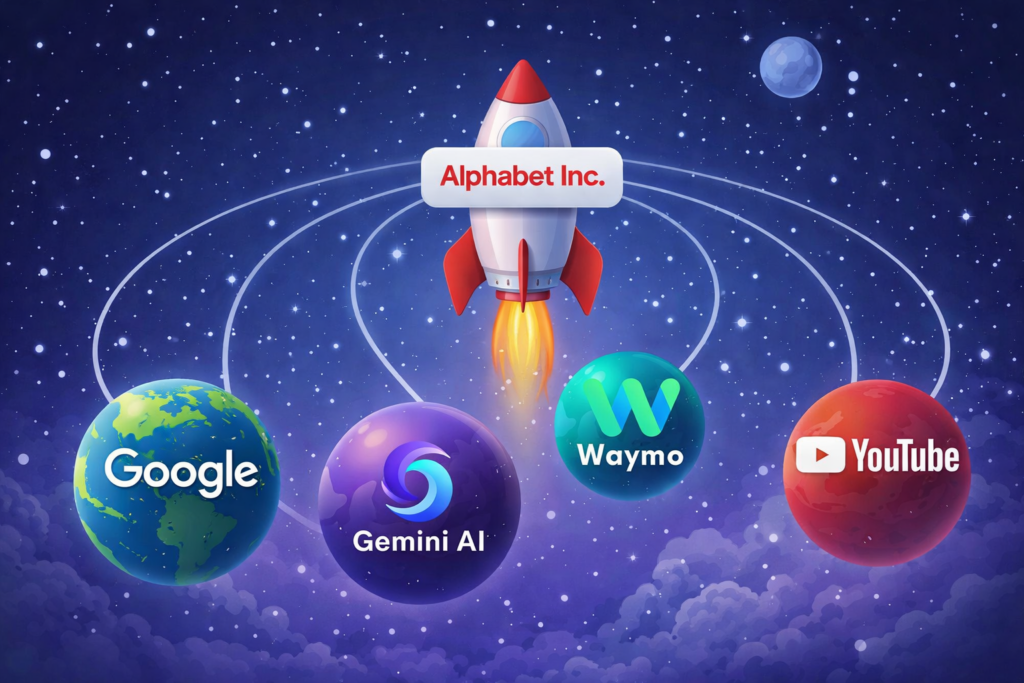
Three Central Storytelling Themes
- “The Infinite Assist”: This is Alphabet’s core “power-up” narrative. It positions Alphabet’s AI, especially Gemini, as an always-available partner that supports users in thinking, creating, and solving problems. The theme frames Alphabet as a seamless extension of human capability, enhancing productivity and unlocking new forms of creativity.
- Technology as a Force for Global Impact: This storytelling theme highlights Alphabet’s commitment to using technology to solve large-scale challenges such as climate change, accessibility, and digital equity. It presents innovation not just as progress, but as a means to create meaningful, measurable impact on society.
- “Curiosity Without Borders”: This theme positions Alphabet as a catalyst for discovery and “what if” moments, encouraging exploration across cultures and disciplines. Highlighting tools from the companies, it reinforces the idea that information is universally accessible, empowering people to explore ideas, cultures, and knowledge without limitations.
Analysis of Storytelling Resonance
- “The Infinite Assist” — Relevance through everyday utility: This theme resonates strongly with AI-Native Young Professionals (25–34) and Next-Gen Digital Learners (16–26) by positioning Alphabet products as a constant productivity and learning companion. It validates their reliance on technology/AI for work, study, and creativity, making the technology feel essential and seamlessly integrated into daily life (McKinsey & Company, 2023).
- Technology as a Force for Global Impact — Alignment with values: This theme appeals to younger audiences who prioritize purpose-driven brands and expect companies to address societal issues like climate change and digital equity. It builds trust and emotional alignment by showing that Alphabet’s innovation goes beyond profit and contributes to meaningful global impact (Deloitte, 2024).
- “Curiosity Without Borders” — Encouraging exploration and learning: This theme connects with both target groups by reinforcing their desire for continuous learning and global connectivity. By highlighting tools like Search and Translate, Alphabet empowers users to explore information freely, aligning with their curiosity-driven behaviors and digital-first lifestyles (Pew Research Center, 2024).
Potential Research Methods
- Survey Research and User Studies: Alphabet likely uses large-scale surveys and user testing to understand how people interact with products like Waymo, YouTube, and Gemini. These methods provide both quantitative and qualitative insights into user needs, behaviors, and satisfaction, helping refine product features and messaging (Pew Research Center, 2026).
- Behavioral Data and Usage Analytics: With billions of users across its platforms, Alphabet relies heavily on real-time data analytics to track user behavior, engagement patterns, and product performance (Statista, 2024). This includes search queries, watch time, and AI tool usage, which inform both product development and storytelling strategies.
- Social Listening and Trend Analysis: Alphabet monitors online conversations, social media trends, and cultural shifts to understand user sentiment and emerging needs. By analyzing discussions across platforms like YouTube, X, and Reddit, the company can adapt its messaging to stay relevant and aligned with audience expectations (Think with Google, 2023).
Three Questions for Further Exploration
- How does Alphabet balance technical complexity with simplicity in its messaging?
- How does Alphabet leverage its interconnected ecosystem, including Search, YouTube, Cloud, and Gemini, to create a cohesive and consistent brand narrative?
- What cultural, technological, and societal trends most influence Alphabet’s storytelling themes and messaging priorities?
Disclaimer: All content included on this webpage was created by Yuxin Tao for a capstone project through the University of Southern California’s Public Relations and Advertising Master’s program. Tao has no official affiliation with Alphabet Inc. or Google.